

Maintaining financial transparency and meeting absolute statutory compliances is a core requisite for every company operating in India. Whether you are a localized startup or a foreign entity looking for our services, understanding the Indian corporate audit framework is paramount to seamless business growth. As leading Practising Chartered Accountants at Bangalore, our team at Aftab & Associates has constructed this guide to simplify your compliance roadmap.
In this comprehensive guide, we will break down the three primary categories of audits that companies encounter: Statutory Audit, Tax Audit, and Internal Audit. Furthermore, we will present an actionable checklist for statutory audit under companies act 2013, analyze the cost of company audit in Bangalore, and outline the benefits of onboarding an experienced statutory audit firm in Bangalore.
1. Understanding Statutory Audits in India
A statutory audit is a mandatory evaluation of a company's financial records, mandated by law, to confirm that its financial statements present a true and fair view of its financial position. In India, every registered company, regardless of its turnover, profit, or corporate size, is legally required to conduct a statutory audit annually under the provisions of the Companies Act, 2013.
Mandate and Regulatory Framework
According to Section 139 of the Companies Act, 2013, shareholders must appoint an independent auditor at the Annual General Meeting (AGM) to conduct the company audit. This independent audit provides assurance to banks, government institutions, investors, and stakeholders that the books are maintained accurately without fraud or manipulation.
Key Note for Foreign Investors: If you are a non-resident or a foreign company looking for our services, you must know that your Indian subsidiaries are subject to the same strict statutory audit mandates. Partnering with a qualified Chartered Accountant in India or a CPA in India ensures your cross-border subsidiary maintains full compliance.
2. Checklist for Statutory Audit Under Companies Act 2013
Preparation is key to a smooth and cost-effective auditing procedure. Here is the exact, low-competition compliance checklist for statutory audit under companies act 2013 that our team uses to audit corporate records:
- Incorporation & Statutory Documents: Verify the Memorandum of Association (MoA), Articles of Association (AoA), Certificate of Incorporation, and Board Meeting minutes.
- Fixed Assets & Depreciation: Maintain a detailed Fixed Assets Register (FAR) highlighting asset additions, disposals, and depreciation calculated as per Schedule II of the Companies Act.
- Inventory Valuation: Complete a physical stock verification certificate and ensure inventory valuation aligns with Indian Accounting Standards (Ind AS / AS 2).
- Bank Reconciliations: Gather bank statement logs and detailed Bank Reconciliation Statements (BRS) for all active current accounts.
- Statutory Liability Verifications: Verify GST registrations, Professional Tax filings, TDS returns, and Provident Fund contributions to ensure zero defaults.
- Transactions with Related Parties: Compile detailed documentation of transactions with related parties under Section 188 of the Companies Act.
3. Tax Audits vs. Statutory Audits: What is the Difference?
Many business owners confuse a statutory audit with a tax audit. While both are critical corporate checks, they serve entirely different legal purposes and are governed by different statutory bodies.
A tax audit is governed under Section 44AB of the Income Tax Act, 1961. The main objective is to verify that the taxable income declared is accurate, tax deductions are claimed appropriately, and the tax computations comply with the Income Tax Act. It must be prepared by a practicing Tax Consultant or auditor.
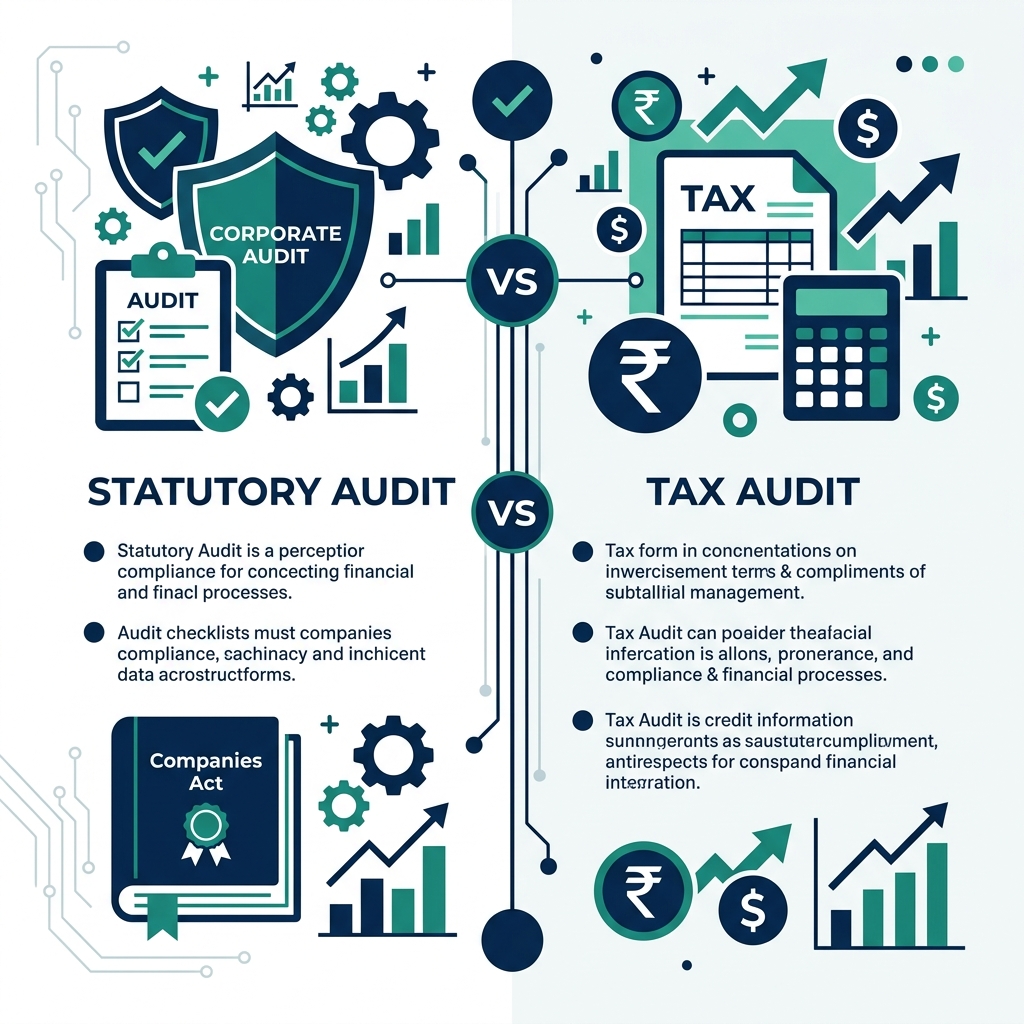
| Criteria | Statutory Audit | Tax Audit |
|---|---|---|
| Governing Law | Companies Act, 2013 | Income Tax Act, 1961 (Section 44AB) |
| Applicability | Mandatory for all registered companies. | Mandatory if business turnover exceeds ₹10 Crore (with cashless caps) or professional receipts exceed ₹75 Lakhs. |
| Primary Objective | Provide assurance on financial state truthfulness. | Ensure compliance with Income Tax laws and prevent tax evasion. |
| Report Form | Auditor's Report & Financial Statements | Form 3CA/3CB and Form 3CD |
4. The Role of Internal Audits in Modern Risk Management
While Statutory and Tax audits are retrospective assessments, an internal audit is a proactive risk management tool. Governed by Section 138 of the Companies Act, 2013, for specified public and private companies, it assesses the effectiveness of internal financial controls, operational workflows, and risk policies.
Implementing an internal audit process for service sector companies or manufacturing setups helps in:
- Detecting and preventing employee operational leakages or asset misappropriation.
- Ensuring strict operational compliance with policies, standard operating procedures, and local regulations.
- Increasing overall operational efficiency, leading to higher profitability and cost optimization.
5. What is the Cost of Company Audit in Bangalore?
A common question startups and small business owners ask is: "What is the average cost of company audit in Bangalore?"
The **cost of company audit in Bangalore** is determined by several parameters: the volume of transactions, the complexity of operations, the quality of bookkeeping, and the scale of the firm. At **Aftab & Associates**, we offer highly cost-competitive and **Affordable CA in Bangalore** packages tailored to startups and SMEs:
- Small Startups / Micro Businesses: Standard compliance fees are highly competitive, designed to support young businesses with quality assurance.
- Medium Sized Entities: Mid-tier pricing based on transactional volume, inventory complexity, and branch structure.
- Large Enterprises / Foreign Subsidiaries: Tailored quotes based on multi-state operations, transfer pricing reporting requirements, and consolidation.
Investing in a premier audit firm saves your business from severe non-compliance penalties, which can range from hefty daily fines to the disqualification of directors.
6. Choosing the Best CA in Bengaluru for Audit Services
When searching for a "CA near me" or the best "GST Consultant" and "Tax Consultant" in Karnataka, prioritize experience, communication clarity, and legal acumen. At Aftab & Associates, we pride ourselves on providing high-quality **Online CA services in India** and physical consultations in our Bengaluru offices.
We are a premier **statutory audit firm in Bangalore**, serving domestic entrepreneurs in Jayanagar, Wilson Garden, and globally based MNCs seeking remote financial auditing. Our digital-first workflows enable rapid, transparent audits, keeping your business fully prepared to attract global investors and stay perfectly compliant with the law.